The text below is reproduced from Abu Iyaad’s article, How the Scholars Dealt With The Fitnah of Ibn Hādī and the Muṣaʿfiqah (opens in a new tab).
At that point, and with Allāh’s praise, the Salafīs of the UK, took a clear, uncompromising, unifying, galvanising strength on the issue, without fearing the blame of the blamers, nor any care for the status of the one who opposed the methodology and harmed Ahl al-Sunnah and their daʿwah a great deal.
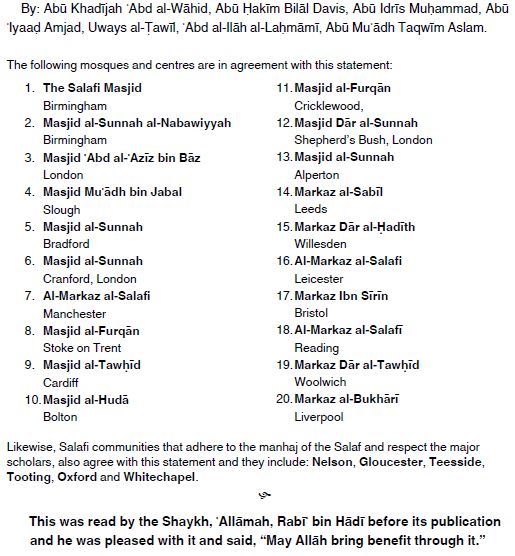
A joint statement was issued on 26 March 2018 in both Arabic and English, approved by Shaykh Rabīʿ, in which the main callers and teachers, along with 20 mosques and centres in the UK made open rejection of what Ibn Hādī had fallen into:
We—Maktabah Salafiyyah—and students of knowledge from London, Bradford, Manchester, Cardiff and other cities make notification that we are with the major scholars in relation to what has taken place recently of revilement of students of knowledge and shaykhs, accusing them of ṣaʿfaqah and passing judgements upon them without evidence or proof.
Based upon what has preceded we say: We free ourselves in front of Allāh from the revilement of Salafīs, accusing them and name-calling them: Allāh the Exalted said: “And do not insult one another and do not call each other by [offensive] nicknames. Wretched is the name of disobedience after [one’s] faith. And whoever does not repent, then it is those who are the wrongdoers.” (49:11-).
Shaykh Rabī said: “So Allāh (عز وجل) has made all of His servants naturally inclined towards the love of justice and hatred of oppression. However, the Muslims are more worthy of abiding by justice and fighting against oppression with respect to wealth, honour and life. The Prophet (صلى الله عليه وسلم) says: ‘Verily, your blood, your wealth and your honours are inviolable among you, just like the inviolability of this day of yours, in this month of yours, in this city of yours’. Hence, it is befitting that we shun oppression and that we do not oppress one other.”
Thus, it is obligatory upon everyone who delved into this fitnah, blindly-followed others and reviled Salafis upon falsehood, abused them and name-called them with “Ṣaʿfūq” and “Ṣaʿāfiqah”, that he repents to Allāh and apologises to the ones he spoke against.
This statement—made three months after Ibn Hādī’s rejection of private advice in November 2017 and three months before Shaykh Rabīʿ addressed Ibn Hādī openly in June 2018—sent a message in the English-speaking Salafī daʿwah that such behaviour will not be tolerated, not even from Shaykh ʿAllāmah Muḥammad Ibn Hādī with whom there was a very strong prior relationship spanning since the early 1990s, and who was held with great respect among senior scholarship.
This is because the law applies to everyone equally, to the ruler, the subject, the scholar and the layman alike, and likewise the honours of all Muslims are inviolable, whether they are paupers or nobles, common-folk, students or scholars.
Due to this timely stance against oppression and violation of the Salafī methodology, the fitnah of Ibn Hādī never affected the English-speaking daʿwah in the West. There were only a few rabble-rousers who fizzled away, but the daʿwah was untouched, and the fitnah was quashed by Allāh’s bounty. The Salafīs remained united, because:
- in clarity there is unity and strength,
- in upholding truth in a timely manner there is support and blessing from Allāh, and
- in denouncing oppression, justice remains and provides shade to everyone.
When these things are not present, then we can be assured of their opposites. Weakness, differing and more injustices on top of the very first one, as punishment and recompense.
This also shows the importance of standing up for the truth, after the scholars and shaykhs who are involved in the issue at hand have made it clear. Meaning, those who have directly engaged with the critiqued individual (or individuals) and have the most knowledge regarding the matter.
It would have been erroneous for someone to say: “Let’s return to Shaykh Muḥammad al-ʿAqīl and Shaykh al-Ruḥaylī” who are sympathetic to the critiqued for advice on how to handle the matter after the truth had already become clear, and the way of the errant has been clearly demonstrated by one or more from Ahl al-Sunnah from the people of knowledge.
This is because the knowledge of these shaykhs is general and not specific, and they have only seen the good, and not the errors and deviations from the methodology that the critics have. However, Shaykh Rabīʿ did advise al-Ruḥaylī, but he did not accept the truth with its evidences, indicating that while earlier he may have been excused due to lack of detailed knowledge in the matter, he did not uphold the truth when it was made clear to him.
Hence, using the slogan, “we must return to the scholars”, but without specifically saying who those scholars are, or intending scholars other than the ones who have established the detailed criticism, a jarḥ mufassar, based on violation of foundations (uṣūl) backed by evidences, with full knowledge of its correctness, then this is not the way of Ahl al-Sunnah in these matters.
Shaykh Rabīʿ said, in response to a doubt of Abū al-Ḥasan al-Maʾribī and his followers regarding “returning to the scholars”:[5]
Returning to the scholars is a mighty affair in Islām and very important, but only in affairs that are confusing to those who are not scholars. As for clear matters such as the affairs in which Abū al-Ḥasan has opposed (the way of Ahl al-Sunnah), then the (other) scholars have no choice but to support and aid the truth and its people, and to restrain the oppressor and instigator of tribulations.
Further, it is not required that other scholars have to agree, because the scholar himself is not the proof, it is the evidence and application of principles that supercede everything and everyone else, including senior scholars. The refutations against Safar and Salmān and others were taken with acceptance, despite the presence of senior scholars who continued to praise them for a period, indicating that it is the principles and the evidences that one is obligated to follow.
Both Fāliḥ al-Ḥarbī and Ibn Hādī, when requested for evidences for their tabdīʿ, claimed or acted as if their scholarly authority alone is sufficient for their speech being accepted. The former, to justify his actions, invented the principle that evidence is required for critiquing the narrators but not innovators, where a scholar’s speech must be taken, without any need for evidence. And as for Ibn Hādī, then he responded with pride and anger, and started lashing out at everyone, and practically speaking, was acting as if his authority was enough for everyone to accept his tabdīʿ.
When the evidence becomes clear, it is obligatory upon everyone who knows it, to support it, even if he has enmity or differing with the one who brought it, and even if it has been brought against the for whom he has love and loyalty. This is what we know as “Salafiyyah”.
Shaykh Rabīʿ said:[6]
My advice to you is to study. If someone has been criticised, study his affair, take the statements of the critics, understand them, and verify their authenticity. Once this becomes clear to you, then judge based on awareness (of the issue) and conviction (of its correctness), not out of blindly following this person or that one, nor out of fanaticism for this person or that one. Leave aside the names of so-and-so and so-and-so.
Take this as a principle and convey it to those opposers so that they may understand the reality, recognise what is right, and remove themselves from the ranks of those who are fanatical towards falsehood.
I am not pleased with anyone being fanatical towards me. If I make a mistake, let whoever finds an error in me tell me that I made a mistake. May Allāh bless you. Do not be fanatical towards anyone, whether it be Ibn Taymiyyah, Ibn ʿAbd al-Wahhāb, Aḥmad ibn Ḥanbal, al-Shāfiʿī, or anyone else. Rather, one’s zeal should be for the truth, and his respect should be for the truth, and you must hate error and hate falsehood.
Here, Shaykh Rabīʿ advised the students to independently study, and not be blind-followers of others. That they should read, investigate, comprehend and seek the truth in the matter. He did not say vote on the matter, or build a consensus for the position you have already taken, or the approach you have decided upon, or the view that suits you and is least inconvenient for you.
Further still, “fitnah” is when the truth and falsehood have not become clear, when the errant has not been distinguished from the correct, the oppressor from the oppressed through the foundational principles (and not the status of any scholar).[7]
This is why Shaykh ʿAlī al-Waṣīfī and Shaykh Ḥasan bin ʿAbd al-Wahhāb al-Bannā said in their August 2018 article, addressing Ibn Hādī::
And we, at the same time, with the bounty of Allāh the Exalted, are certain that the foundations (employed by) Shaykh Rabīʿ derived from the Book, the Sunnah and the understanding of the Salaf are more greatly rooted in knowledge, actualisation of justice and zeal for the Sharīʿah than you.
When the criticising scholars and shaykhs have made the affair clear, then they should be returned to and consulted for advice and guidance on how to write or convey the stance which has become binding to take, as they are most knowledgeable of it, as they are the ones clarifying the errors and deviations. Hence, the Salafīs of the UK took the stance against oppression, and then made it known to send a message of zero tolerance for this conduct within the ranks of Ahl al-Sunnah, regardless of the status of the person involved.
Likewise, when a scholar, or group of scholars who are directly involved in the matter, themselves, openly state the truth regarding the criticised, and publish and disseminate their materials for public consumption, having laid out all the evidences, after the processes of dialogue, advice, correction, sincere appeals and so on—in compliance with principles of methodology—then there is no blame for anyone translating or conveying what is in those writings after the truth with its evidences has become clear and the scholars with that proof have already spoken openly and issued warnings.
This constitutes returning to the scholars and is not “preceding the scholars” in any way. This is because the truth has already become clear, and they openly spoke about it, and disseminated it. Thereafter, others are required to support and uphold it, so that others are not deceived and misled.
Muḥammad bin Hādī had a lofty status, respected by senior scholars in Riyāḍ, likewise in Jāzān, Makkah, Madīnah, and thousands upon thousands of students were attached to him, given his decades long recognition as a staunch and astute person of the Sunnah. That did not prevent a clear, open stance being taken, when he opposed the foundations and refused to turn back, and all of this revolved around one main issue: how to deal with Ahl al-Sunnah and their errors.
Footnotes
- In his article, “Barāʾah Ahl al-Sunnah mimmā Nusiba Ilayhim Dhū al-Fitnah (pp. 5-6). ↩
- From the tape recording, "Khuṭūrat al-Kadhib wa Āthārihī al-Sayyiʾah wa Mawqif al=Islām Minhu" (minute 56:44). ↩
- It is not the scholar himself who is the proof, but the evidence he provides and application of the principles of the Salafī methodology which obligate its acceptance, whether he is a senior scholar, or one less than him. ↩