The text below is reproduced from Abu Iyaad’s article, How the Scholars Dealt With The Fitnah of Ibn Hādī and the Muṣaʿfiqah (opens in a new tab).
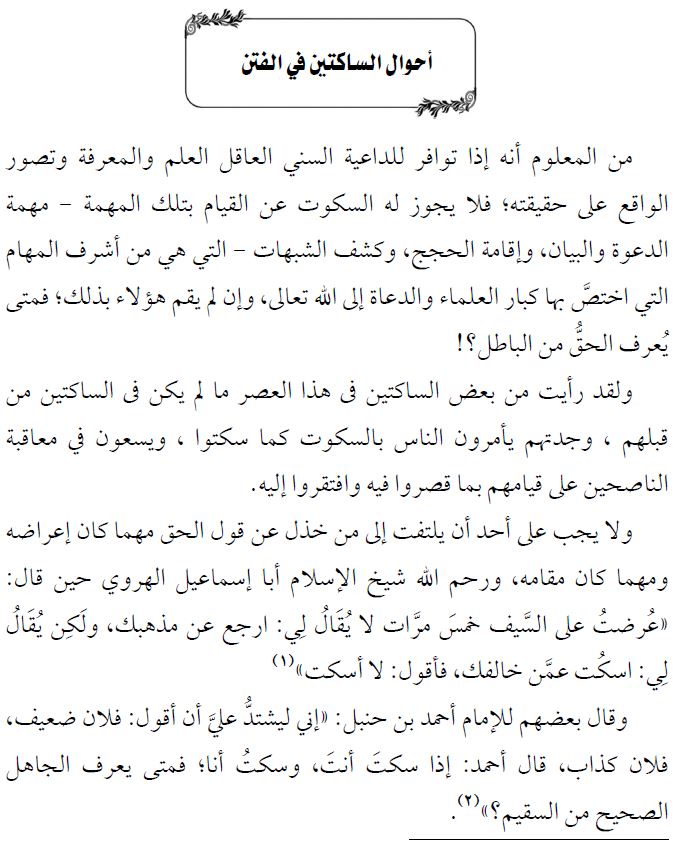
In his excellent work, “Radd al-Ishkālāt wa Kashf al-Mubhamāt” (1441/2020) regarding the fitnah of Muḥammad bin Hādī, Shaykh ʿAlī al-Waṣīfī (رحمه الله) placed a few chapters on those who remain silent during tribulations. In the chapter: “The States of Those Who Remain Silent During Fitan” he explains that it is not permissible for the caller who has knowledge and comprehension of the issue and its reality to remain silent from the important duty of calling, clarifying and establishing the proofs and removing the doubts. The shaykh said that if the scholars and the callers do not do that, then when will truth be known from falsehood?
He then says:
I have seen from some of the silent ones in this era what I have not seen from the silent ones before them. I found them ordering people to remain silent like they (themselves) have and they strive to punish the sincere advisors for performing (the obligation) that they (themselves) fell short in, and were in need of (doing themselves). And no one must turn to those who deserted the (duty) of speaking the truth, whatever (the nature of his) avoidance, and whatever his status.
May Allāh have mercy upon Shaykh al-Islām Abū Ismāʾīl al-Ḥarawī when he said: “I was subjected to the sword five times, it was not said to me: ‘Leave your doctrine’, but it was said to me: ‘Keep silent about those who oppose you’, so I said: ‘I will not remain silent.’” And some of them said to Imām Aḥmad bin Ḥanbal: “I find it hard to say that so-and-so is weak and so-and-so is a liar.” Aḥmad said: “When you remain silent and I remain silent, when when will the ignorant person know the authentic from the defective?”
The shaykh went on to explain that silence is only for the one who does not know, does not understand and is unable to establish the proof. As for the one who has some knowledge, understanding, ability to clarify, has comprehended the matter, and is able to face up to the tribulation that has reached people and he has people that look up to him, such as students, then is not permissible for him to remain silent, with the argument of “keeping far away from fitnah”, because he in reality is already steeped in it, and is not far away from it (by remaining silent).
He then says:
It is must for every caller to investigate the issues, make the rulings clear, and aid the oppressed. And if every man fled from every dispute and every tribulation, and did not strive to destroy it (i.e. end it), and did not explain the truth about it which is the legislative obligation, then Islām will not remain standing, and the Muslims will not retain strength, and Ahl al-Sunnah will become weak, and the people of innovation will become strong.
After this general chapter, he then places another lengthier chapter on those who remain silent in the fitnah of Muḥammad bin Hādī specifically. In order not to prolong the matter, we can summarise it.
The essence of it is that those who remained silent are not excused even if the nature of the innovation of Ibn Hādī is not like the major innovations of the Khārijites, the Rāfiḍah, the Ṣūfiyyah and so on. Despite this, he fell into reviling shaykhs and students, expelling them from Ahl al-Sunnah, splitting Salafīs, and all of this must be shown rejection by the one who has comprehended the matter and is able to do so.
He says that the people of truth are in between categories:
Either the opposer who contends and disputes, or the deserter who flips (changes colours). While the people of the Aided Group (al-Ṭāʾifah al-Manṣūrah) are very few, they perform what Allāh the Exalted obligated upon them of aiding the truth, and they are not harmed by those who abandon them, or those who oppose them.
Hence, there are the people of truth, and they are in between the opposers and the deserters. Then he mentions various categories and they are:
The weak in religion who do not aid the truth except rarely, and the weak in knowledge who are unable to face people with proofs and evidences.
Then the weak in character, and they are the cowards who do not have the courage, unable to be straight with themselves, let alone be straight with others.
Then there is another group of silent ones who are chameleons (shifting positions and alliances). They present themselves as silent, but they only seek their own beneficial interests, and what will bring benefit to them.
Among this group are those who say: “We have no connection to this fitnah”, but in the reality of the affair, he is upon other than this, he does not aid the truth, and nor does he want anyone to aid the truth, and if anyone does, he drives him away and boycotts him.
And then there are those who think that the fitnah does not go beyond the people involved, and such ones do not look at the effects and outcomes of the fitnah upon them and their students. Rather, they contradict themselves, because they do not leave alone those who oppose them, whether in a minor or major matter, without replying to them with zeal and revenge, and with the ugliest of words in which none of the Salaf preceded them, without looking at the outcomes, but then why did such zeal die in the fitnah of Ibn Hādī?
And another group among these last ones are those who do not know the details of what Ibn Hādī fell into from the point of view of knowledge and methodology, but they only look from the perspective of their own desires.
Then he explains reality of the silent person who is excused and not reviled for his silence:
It is the one who remains silent due to inability, weakness in knowledge and understanding, while having a good intention, but fear (waraʾ) has prevented him from speaking about what he has no knowledge of, or that he undertake what he has no ability to bear. So this one knows the limitations of his self, and stops at its limit, and does not enter the affair absolutely, neither negatively nor positively. He stands between the two ranks, he does not aid these ones, nor those ones, and nor does he have the ability to do so, neither in knowledge, nor in his self, in front of the pressures of the situation. So these types, the scholars withheld, by consensus, from reviling them and cutting off from them (for their silence and lack of participation).
Note: This is the one who is excused, and this contrasts with the way of the “Sukūtiyyah”, those who say that since they have not spoken on an issue, neither one way or the other, they are not obligated to say anything. However, they fully comprehend the issues, are aware of right and wrong, hold sway over people, both students and common people, are able to speak and clarify, know that the fitnah has engulfed people and is causing chaos and turmoil around them, but choose not to do so.
Then Shaykh ʿAlī al-Waṣīfī said:
ʿAllāmah Shaykh Rabīʿ spoke about those to whom the truth became clear in that fitnah and knew the details, but remained silent and did not support it despite being able. So he blamed him and crticised him for doing that because the one who remains silent about the truth, when he is able to clarify it, is a mute devil, as some people of knowledge have said. It is established from the Messenger (صلى الله عليه وسلم) that he said: “When people see an evil and do not change it, Allāh is about to envelope all of them with punishment.”[11] This is why ʿAllāmah al-Rabīʿ said: “Take knowledge from the clear ones.”
Note: In the fitnah of Ibn Hādī, Shaykh Rabīʿ distinguished between the Wāḍiḥīn (clear ones) and the Sukūtiyyah (silent ones), those who invoke “no obligation to speak”, “observance of maṣāliḥ and mafāsid” and “avoiding fitnah”. It is Shaykh Rabīʿ who made this important distinction in that fitnah. However, there is a new approach, which extends the approach of Ibrāhīm al-Ruhaylī and his likes, of making Salafīs become fearful and averse to following principles and evidences and upholding the truth. Remaining silent about the fitnah of Ibn Hādī of of tabdīʿ and tajrīḥ, after his stubbornness and rejection was apparent by end of 2017, is not avoiding fitnah or observing the maṣāliḥ and mafāsid. The Wāḍihīn bring clarity, strength of position, upholding of truth, and strength of unity upon clarity, and the Sukūtiyyah bring confusion, bewilderment and desertion of what is necessitated of speech and action.
Footnotes
- Al-Tirmidhī (no. 2167), declared ṣaḥīḥ by Shaykh al-Albānī in al-Silsilah (no. 1564). ↩